
Creating safe accommodation for women and children affected by domestic and family violence requires more than simply building houses. It means understanding what safety, stability and independence really look like for the people who will call those houses home.
That understanding has guided every step of our first Queensland development. With six purpose-built townhouses now in the planning stages, we’re excited to share how extensive research, consultation and the lived experiences of victim-survivors have shaped our approach.
.
Listening before designing
Before we began searching for land, we spent eight months researching what our accommodation should look like and, more importantly, what it needed to achieve.
We consulted with domestic and family violence support organisations, refuges, police, local and state government representatives, builders and other industry specialists.
But some of our most valuable insights came directly from women who had experienced domestic and family violence themselves.
In October 2025, we met with a focus group of victim-survivors who generously shared their experiences, perspectives and ideas. Their feedback helped us understand the practical and emotional considerations that can make an enormous difference when someone is rebuilding their life.
It reinforced something fundamental to our mission: the homes themselves can play an important role in supporting safety and recovery.
By December 2025, we were working closely with our architect to translate those insights into a development brief.
Safety and privacy, designed from the beginning
For women and children who have experienced domestic and family violence, feeling safe in their own home is especially significant, so security and privacy have been central to our planning from the outset.
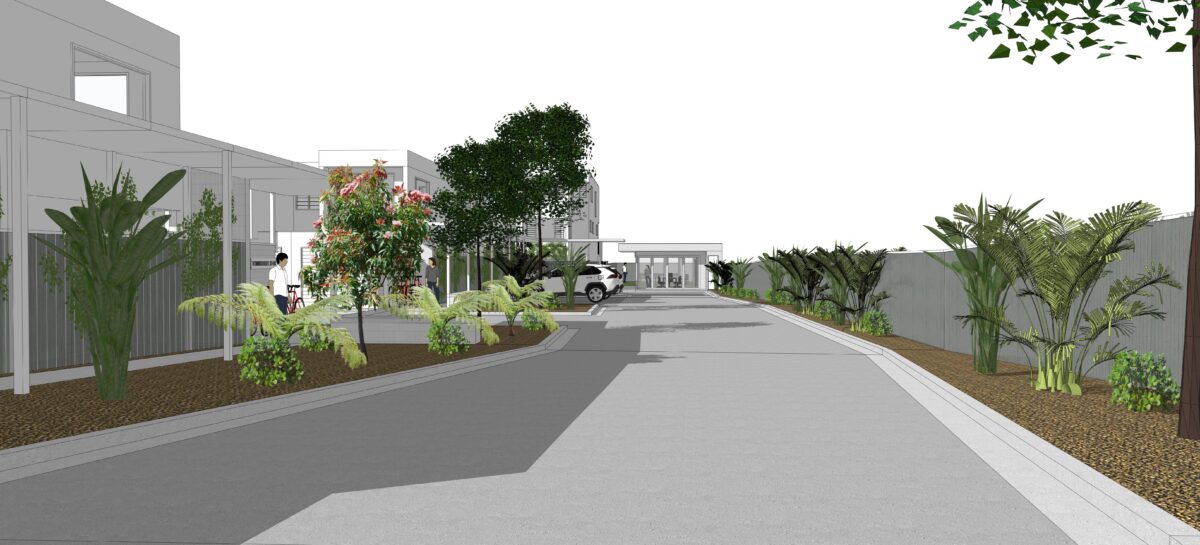
Our proposed development will comprise six three and four-bedroom townhouses within a secure complex, incorporating considered access arrangements, security measures and private living spaces.
One particularly important feature is a dedicated onsite visitor and service centre. This will provide a separate space where residents can meet with support workers, service providers, family members and other visitors without compromising the privacy of their homes.
For families who may never have experienced a truly safe personal space, that separation is an important part of creating a sense of security and independence.
We’ve also incorporated plans for a communal outdoor area, recognising the value of connection and shared experiences while ensuring residents can choose when and how they engage with others.
Creating homes for families of all sizes
Finding suitable accommodation can be particularly challenging for women with multiple children. Larger families may face limited housing options, adding another layer of difficulty during an already challenging period.
Our first development has therefore been designed around three and four-bedroom townhouses, providing the space needed to accommodate different family structures.
We’ve also considered practical details such as storage, parking and furnishing, recognising that families arrive with different needs and circumstances.
These considerations may seem small individually, but together they contribute to homes that are more comfortable, functional and supportive of everyday family life.
Location matters just as much as the homes
Choosing the right location was another major focus of our research. Access to schools, healthcare, public transport, employment opportunities, shopping and community services can make a significant difference to a family’s ability to rebuild their independence.
For that reason, we established clear location criteria before beginning our search for land.
We prioritised areas with convenient public transport, access to essential services and opportunities for residents to remain connected with their communities.
We also considered the affordability of surrounding rental markets. Our goal is to help women and families move towards permanent, independent housing. Being located in an area where they may eventually be able to afford to rent independently can make that transition more achievable.
We recognise, too, that every family’s circumstances are different. Some women may wish to remain close to existing support networks, while others need the opportunity to establish themselves somewhere entirely new.
As North Star Foundation grows, developing accommodation across different locations will help provide more options for the families we support.
Providing the stability needed to move forward
Our accommodation is intended to support women and children as they transition from crisis towards longer-term independence.
Through our consultation process, we heard different perspectives on how long families may need this support.
While some victim-survivors emphasised the importance of helping residents move forward and making accommodation available to others in need, support organisations highlighted how much time recovery and rebuilding can take.
For families with children, stability is particularly important. Moving repeatedly between temporary accommodation can disrupt schooling, routines and the sense of security children need.
These conversations helped shape our proposed accommodation model, which anticipates stays of approximately two years, depending on individual circumstances.
Residents will be referred through domestic and family violence support organisations, allowing North Star Foundation to work alongside services with the specialist expertise to support each family’s recovery.
Our aim is to provide a stable foundation from which residents can plan their next steps towards permanent housing.
From vision to reality
In February 2026, we signed the contract to purchase our first Queensland development site.
Since then, our project team has been progressing the planning and design process, working with architects, town planners and other specialist consultants.
In October 2026, we reached another important milestone with a pre-lodgement meeting with council to discuss the proposed development and identify any considerations ahead of submitting our development application.
Land settlement is scheduled for November/December 2026, with possession expected in February 2027. Our first residents currently expected to move into their new homes in February 2028, subject to approvals and construction timelines.
While this first development has required extensive groundwork, the research and planning completed will also help inform future projects.
We’re already exploring additional sites as we work towards our goal of delivering 100 homes by 2032.
More than a roof over their heads
For North Star Foundation, the purpose of these homes goes well beyond providing accommodation. We want to create places where women and children can feel safe, establish routines, maintain important connections and begin to look towards their future with confidence.
Every decision, from the size of the homes to the location of the development and the way support services can be accessed, has been considered through that lens.
We’re incredibly grateful to the victim-survivors, support organisations and professionals who have shared their knowledge and experiences throughout this process.
Their contributions are helping us create homes that respond to the real needs of the people who will live in them.
Six homes are now taking shape. And while this is only the beginning of our journey, it’s an important step towards a future where more women and children have a safe place to rebuild their lives.